EMT Practice Test

1. Question Content...


Question List

Question1: An administrator cannot enable multi-processor Fault Tolerance (SMP-FT) for a virtual machine.
Which are two possible causes for this? (Choose two.)

Question2: An administrator has enabled vSphere Distributed Switch Health Check. The hosts connected to that Distributed Switch all display an alert:
vSphere Distributed Switch MTU supported status
The administrator has all of the VMkernel ports MTU sizes set to 1600.
Which action will remedy this problem?

Question3: vSphere DRS helps to balance virtual machines with available resources in a vSphere cluster.
What three types of resources can be taken into account for balancing? (Choose three.)

Question4: Which two statements correctly describe VM-Host affinity rules? (Choose two.)

Question5: Which statements regarding datastore clusters meets VMware's recommended best practices?

Question6: What are three benefits of using a few large-capacity LUNs instead of many small-capacity LUNs? (Choose three.)

Question7: What is the correct way to replace the certificate on an existing vCenter Server that is part of a vCenter HA configuration?

Question8: Which is required by vCenter Converter Standalone to convert a physical Red Hat
Enterprise Linux 7 machine to a virtual machine?

Question9: An administrator must change the statistics level for short-term performance monitoring and wants to collect metrics for all counters, excluding minimum and maximum rollup values.
What would be the statistics level?

Question10: A vSphere Administrator must ensure that a user is able to view and manage the system configuration in vSphere Web Client.
In the vCenter Single Sign-On domain, which group should the user be a part of?

Question11: What two methods are used to configure VMware vSphere Storage I/O Control shares and limits? (Choose two.)

Question12: Which quest operating system supports PVRDMA?

Question13: What VM Monitoring setting would ensure that the failure interval for a virtual machine is defined as 120 seconds?

Question14: Which network is used by vSphere HA when VMware vSAN is enabled?

Question15: An administrator is trying to vMotion a VM from his datacenter to a recovery site. Which is the maximum allowed RTT (Round-Trip Time) latency between source and destination host?

Question16: An administrator is creating VMkernel adapters on an ESXi 6.5 host and wants to create separate VMkernel adapters for every type of traffic in the default TCP/IP stack.
Which three types of traffic can be explicitly enabled on a separate VMkernel adapter?
(Choose three.)

Question17: An administrator sets the Failover Capacity for both CPU and Memory at 25%.
Based on the Exhibit below, how much of the cluster's total CPU resources are still available to power on additional virtual machines?

Question18: By default, how often is the vCenter vpx user password automatically changed?

Question19: An administrator is attempting to power on a virtual machine with 32GB of memory. The operation fails with the following error:
Could not power on VM: No space left on device
Checking the space on the virtual machine's datastore, there is 30GB free.
Which action would allow the VM to power on?

Question20: Which method is supported for backing up the virtual machine that contains vCenter
Server?

Question21: Which two permissions are required to migrate a virtual machine with Storage vMotion?
(Choose two.)

Question22: How can a vSphere administrator ensure that a set of virtual machines run on different hosts in a DRS cluster?

Question23: In which scenario will vSphere DRS balance resources when set to Fully Automated?

Question24: What three processes on the vCenter Server Appliance (VCSA) does "vmware-watchdog" monitor? (Choose three.)

Question25: Which command can be run to troubleshoot connectivity problems with vmkernal network interfaces?

Question26: After upgrading the vSphere infrastructure and VMware Tools to version 6.5, the "Upgrade
VM Compatibility" option is grayed out in the vSphere Web Client. (See Exhibit.)

What must the administrator do to enable the VM compatibility upgrade?

Question27: The storage vendor recommends adjusting the Fibre Channel HBA queue depth to resolve a performance problem.
Which esxcli namespace can a vSphere Administrator use to adjust the queue depth?

Question28: Which three types of Content Libraries exist within vSphere 6.5? (Choose three.)

Question29: Boot from SAN is supported on which three storage technologies? (Choose three.)

Question30: What is the minimum number of hosts that must contribute capacity to a non-ROBO single site VMware vSAN cluster?

Question31: What VMware technology can be used to move physical servers to the vSphere infrastructure?

Question32: Which three requirements are needed to apply RAID 5 or RAID 6 erasure coding on a vSAN 6.2 or 6.5 object? (Choose three.)

Question33: What two debugging levels can a virtual machine be configured to? (Choose two.)

Question34: Assuming a mirrored (RAID-1) object configuration, how many hosts must contribute storage in a non-stretched VMware vSAN cluster to satisfy the "Number of failures to tolerate" policy option?
"n" is the desired "Number of failures to tolerate" value for all options.

Question35: Which two configurable options are available in Boot Options for a virtual machine?
(Choose two.)

Question36: Which is the correct order for upgrading vSphere components?

Question37: Storage capabilities be populated in what two ways? (Choose two.)

Question38: An administrator attempts to manually reclaim space on thin-provisioned VMFS6 volumes but finds that no additional space is being recovered.
Which could be causing this?

Question39: An administrator has upgraded to vSphere 6.5 and also wants to use Kerberos authentication for NFS.
Which can be done to the existing NFSv3 volumes to enable this feature?

Question40: A vSphere Administrator wants to reserve 0.5 Gbps for virtual machines on each uplink on a disturbed switch that has 10 uplinks.
What is the quota that should be reserved for the network resource pool?

Question41: An administrator has recently upgraded from vSphere 6.0 to 6.5, and can no longer see the software iSCSI named vmhba33.
Which could be the reason for this?

Question42: An administrator wishes to enable network port mirroring based on source port. Which feature should be enabled?

Question43: Which storage feature always requires the use of third-party software on ESXi?

Question44: An ESXi host's VMCA-Signed certificate has expired. How can the certificate be renewed?

Question45: What three conditions could result in VMware Flash Read Cache being unable to claim a disk? (Choose three.)

Question46: A vSphere content library administrator is attempting to unpublish the content library, but the option is grayed out as shown in the Exhibit.

Which statement identifies the reason for not being able to unpublish?

Question47: Where would a vSphere administrator find general vCenter Server logs on a vCenter
Server Appliance?

Question48: A security officer has issued a new directive that users will no longer have access to change connected network adapters to limit denial of service on a virtual machine.
Which two correct virtual machine advanced configuration parameters will accomplish this?
(Choose two.)

Question49: Which three statements are correct regarding booting an ESXi Host from Fibre Channel
SAN? (Choose three.)

Question50: In network troubleshooting it is important to know what upstream switch the ESXi host is connected to.
Which two features does ESXi provide to help identity the upstream switch? (Choose two.)

Question51: Which are three supported storage requirements for vCenter Server HA? (Choose three.)

Question52: The administrator wants to power on VM-K2, which has a 2GHz CPU reservation. VM-M1,
VM-M2, and VM-K1 are all powered on. VM-K2 is not powered on.
The exhibit shows the parent and child resource reservations.

If Resource Pool RP-KID is configured with an expandable reservation, which statement is true?

Question53: A vSphere administrator manages a cluster which includes critical and non-critical virtual machines. The cluster requires different permissions for contractors and non-contractors.
How can the administrator exclude the contractor group from some of the critical VMs?

Question54: Which statement applies to the vSphere Replication appliance?

Question55: Which two statements about vCenter HA are correct? (Choose two.)

Question56: vCenter Server Appliance Instance can be backed up using which Client Interface?

Question57: A vSphere Administrator observes that the Primary VM configured with Fault Tolerance is executing slowly. After further investigation, it is determined that the Secondary VM is on an overcommitted ESXi host.
What two methods will correct the problem? (Choose two.)

Question58: When enabling Storage DRS on a datastore cluster, which three components are enabled as a result? (Choose three.)

Question59: An administrator finds that the Microsoft Exchange virtual machines are exhibiting network latency.
What two in-guest changes can help decrease latency? (Choose two.)

Question60: An administrator sees the following error in the log files:

Which two events could be the source of the error message? (Choose two.)

Question61: Which two featured require the use of Host Profiles? (Choose two.)

Question62: If vCenter Server 5.5 installation has one or more services deployed remotely, which three services are relocated to vCenter Server 6.5 on upgrade? (Choose three.)

Question63: What is a potential downside of having more than four paths per datastore?

Question64: In vSphere Data Protection 6.1, which is the function of a Backup Verification job?

Question65: Which is the maximum number of block devices (LUNs) that are supported by ESXi hosts that are running version 6.5?

Question66: A vSphere HA cluster with four hosts has admission control configured to tolerate one host failure.
Which statement is true if a fifth host is added?

Question67: What is the result of a "Consolidate" action on a virtual machine?

Question68: Which iSCSI initiator type can be used with any network interface card?

Question69: What counter should an administrator check to determine if a virtual machine is ballooning?

Question70: Which two components are part of storage I/O multipathing on ESXi? (Choose two.)

Question71: What are two features introduced in Network I/O Control version 3? (Choose two.)

Question72: What advanced parameter defines a custom isolation IP address for a vSphere HA cluster?

Question73: Which statement is correct when migrating from a Windows vCenter Server to the vCenter
ServerAppliance 6.5?

Question74: Which two storage configurations on the source server are unsupported with VMware
Converter? (Choose two.)

Question75: Which is required for configuring iSCSI Software Adapter network port binding?

Question76: Which feature facilitates the sharing of templates via vCenter Server?

Question77: The vSphere Data Protection performance analysis results in the "Conditionally Passed" status.
What can cause this condition?

Question78: An administrator wants to restore the vCenter Server Appliance 6.5 from backup.
Where can this be accomplished?

Question79: Which two statements are true for a vCenterServer user account that is used for vSphere
Data Protection (VDP)? (Choose two.)

Question80: Which are the two network requirements for a VMware vSAN 6.5 cluster? (Choose two.)

Question81: What are two requirements to enable EVC in vSphere DRS cluster? (Choose two.)

Question82: The business managers have asked the IT administrator to ensure configuration compliance in the vSphere infrastructure. The IT administrator wants to use Host Profiles to accomplish this, but is unable to do so.
Why is the administrator unable to use Host Profiles?

Question83: What availability mode does vCenter HA provide?
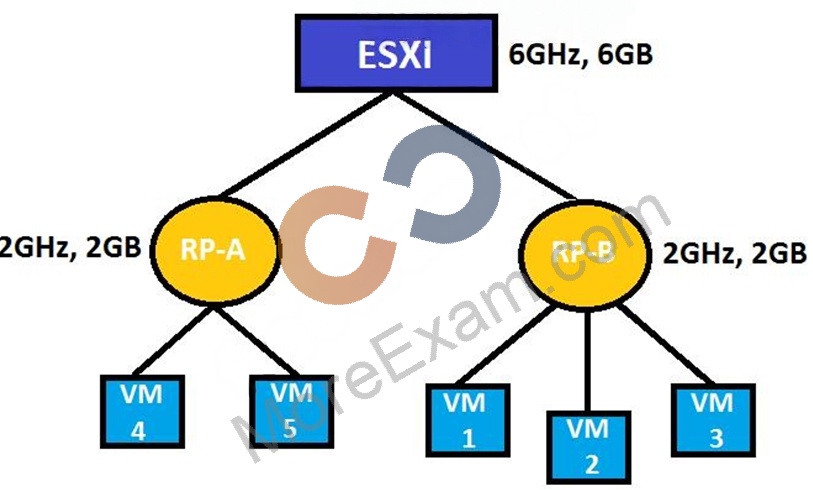
Question84: In a vSphere environment, two resource pools are created as shown in the Exhibit.

Each VM is configured with 1 GB of memory. When the administrator tried to power on
VM3, the operation failed.
What action in the resource pool settings will allow VM3 to power on successfully?

Question85: Which three are supported upgrade processes for ESXi host? (Choose three.)

Question86: When installing vCenter Converter Standalone, why must an administrator perform a client- server installation instead of a local installation?

Question87: A vSphere Administrator attempts to enable Fault Tolerance for a virtual machine but receives the following error:
Secondary VM could not be powered on as there are no compatible hosts that can accommodate it.
What two options could cause this error? (Choose two.)

Question88: An administrator wants to enable proactive HA by moving virtual machines automatically if a hardware alert is triggered.
What are the three required settings? (Choose three.)

Question89: ESXi 6.5 introduces VMFS6, which supports both 512e and 512n devices.
What three configurations are supported when using these devices? (Choose three.)

Question90: Which are two vCenter Server two-factor authentication methods? (Choose two.)

Question91: Virtual Volumes supports which three VMware features? (Choose three.)

Question92: Which two types of iSCSI adapters require VMkernel networking configuration? (Choose two.)

Question93: Which Host Profile Subprofile configuration is used to configure firewall settings for ESXi hosts?

Question94: What is the VMware-recommended best practice for Fibre Channel zoning?

Question95: An administrator has multiple vCenter Server 6.5 systems but cannot enable Storage I/O
Control (SIOC) on a datastore shared by ESXi hosts managed by the vCenter Server systems.
Which action should the administrator take to resolve the issue?

Question96: The virtual machine log rotation size can be changed for all VMs by which two interfaces?
(Choose two.)

Question97: Which two tasks should a vSphere administrator perform if the vmkernel log reports VMFS metadata errors? (Choose two.)

Question98: Which three design requirements must be satisfied to enable RAID-6 objects in a VMware vSAN cluster? (Choose three.)